

There’s a strange place many successful people eventually find themselves in.
It’s not failure.
It’s not crisis.
And from the outside, nothing even appears wrong.
The business is running. The career is stable. The results are still there. If anything, things are working better than they ever have.
Yet internally, something feels off.
Momentum feels slower. The excitement that once fueled long days and big ambitions starts fading. Work that once felt challenging now feels routine. You still show up, still perform, still deliver — but the energy behind it isn’t the same.
It’s the quiet realization that you might be stuck in a game you’ve already mastered.
For high performers, this moment can be deeply confusing. We’re taught to associate feeling stuck with failure, so when the feeling shows up while everything is technically going well, it creates doubt. You start asking yourself uncomfortable questions.
Is this the best I can do?
Have I peaked?
Am I losing my edge?
But in most cases, none of those things are true. What’s actually happening is far more common — and far more solvable.
You’ve simply outgrown the level you’re currently playing at.
Success has a way of quietly creating comfort. The habits that once required discipline become automatic. The strategies that once felt innovative become routine. The environment that once pushed you begins to feel predictable.
And while consistency is one of the greatest drivers of achievement, repetition without challenge slowly drains momentum.
The danger is that playing too small rarely looks like quitting. In fact, it often looks responsible. You’re doing what’s expected. You’re keeping the machine running. From the outside, people might even compliment how steady things look.
But internally, curiosity begins to fade. Energy dips. Motivation drops. What many people label as burnout is sometimes something entirely different — a lack of challenge.
You’re not tired of working.
You’re tired of playing a game you’ve already figured out.
History is full of examples of how quickly the world evolves when people push into new challenges. At the beginning of the twentieth century, the idea of driving across the country in an automobile sounded unrealistic. The idea of humans flying through the sky sounded impossible.
Yet within a couple of decades, those breakthroughs became everyday realities.
The world we live in today moves even faster. Technology, artificial intelligence, and entire industries are changing at speeds that compress decades of progress into a few short years. Standing still isn’t really standing still anymore — it’s falling behind.
That’s why reinvention isn’t something reserved for people who failed.
It’s something practiced by people who refuse to stagnate.
Unfortunately, the word reinvention often carries the wrong meaning. Many people assume it means starting over, abandoning everything they’ve built, or walking away from success.
But real reinvention doesn’t erase your past.
It builds on it.
It’s not a reset. It’s a progression.
The strongest performers understand this instinctively. They evolve their goals, expand their thinking, and look for new challenges that demand more from them than the last one did. Not because the previous level was bad — but because growth requires movement.
One of the most powerful lessons in goal setting is that not all goals create momentum.
If your next goal simply repeats what you’ve already done before, it might feel productive, but it rarely generates excitement. Real energy comes from goals that stretch you — goals that are possible but not yet clear.
A goal that forces you to grow.
A goal that requires new thinking.
A goal where you don’t fully know the path yet.
Those are the kinds of goals that bring momentum back to life.
Because momentum isn’t fueled by comfort. It’s fueled by expansion.
Many high achievers eventually recognize this moment as the transition between levels. The place where the skills and habits that once created success are no longer enough to carry you forward.
It’s the realization that you might still be playing on the junior varsity team, even though you’re ready for the varsity game.
That recognition can feel uncomfortable, but it’s also incredibly powerful. It means you’re not stuck because you’re incapable. You’re stuck because your next chapter hasn’t been defined yet.
And once you define it, everything changes.
The truth is, every successful life is made up of multiple seasons. Multiple reinventions. Multiple evolutions of identity, skill, and purpose.
The people who continue to grow aren’t the ones who avoid change.
They’re the ones who choose it before stagnation forces it on them.
So if you find yourself in that quiet place where things are still working but something feels different — don’t panic.
You’re not broken.
You’re not behind.
And you certainly haven’t peaked.
You’ve just mastered the game you’re playing.
Which means the real question isn’t whether you’re capable of more.
It’s what game you’re ready to play next.
Ready to Reignite Your Momentum?
If you’re feeling stuck despite success, the solution isn’t working harder — it’s choosing a bigger vision.
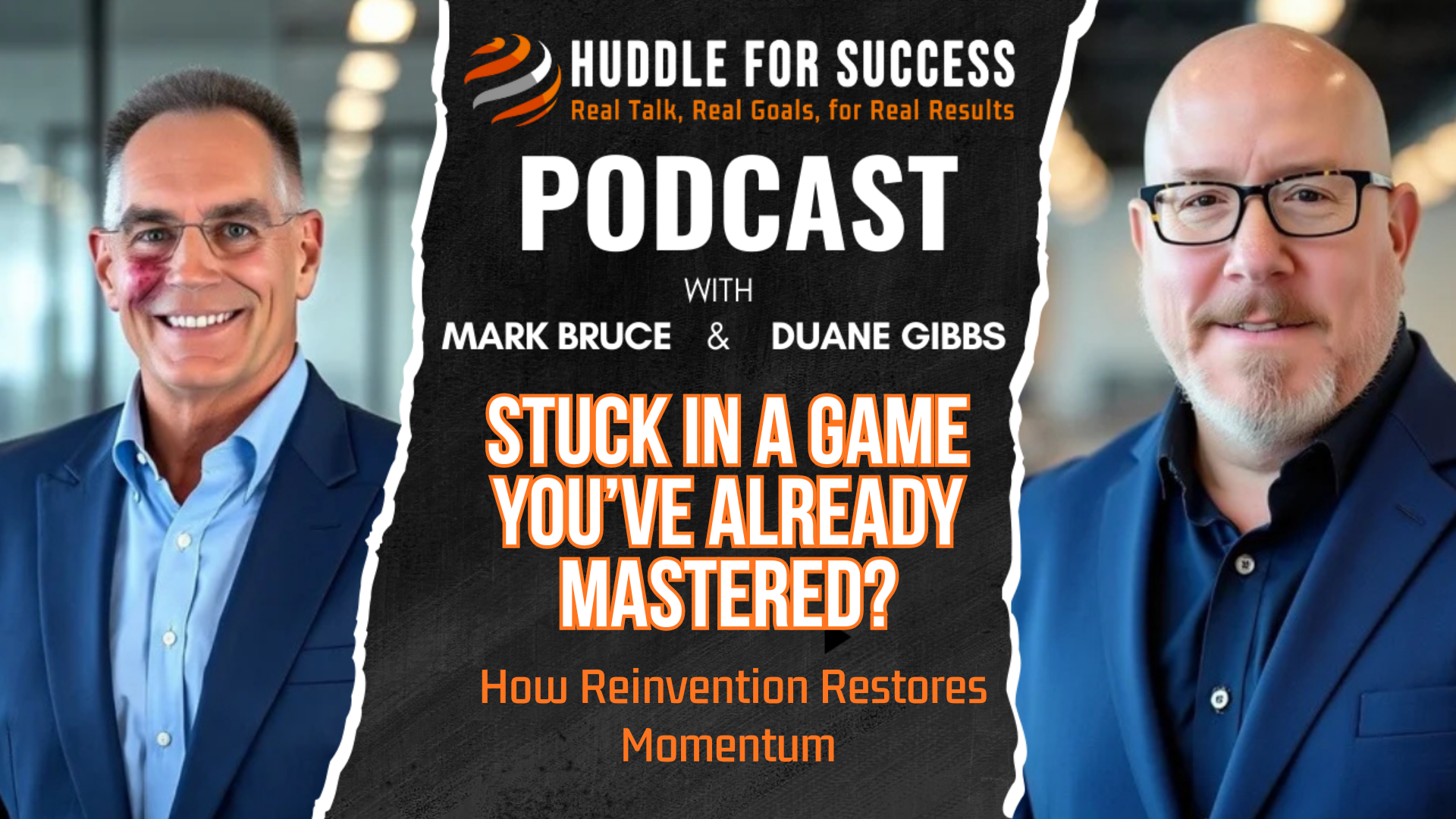
Inside the Playbook for Life, Mark Bruce and Duane Gibbs share the mindset principles and strategies used to help high performers break through plateaus and step into their next level of growth.
Book a discovery call with Mark or Duane today and start building the next chapter of your success.
